Ronald Leung’s original, dated commentary is reproduced below. Views, invitations and product references reflect the time of publication; they are not investment advice, an offer, a guarantee of return or confirmation of current availability.
A journalist friend asked me this week whether tokenised gold is regulated by the Hong Kong SFC.
I couldn't answer, unless it is a tokenised investment product. It depends on the legal structure the gold is held in.
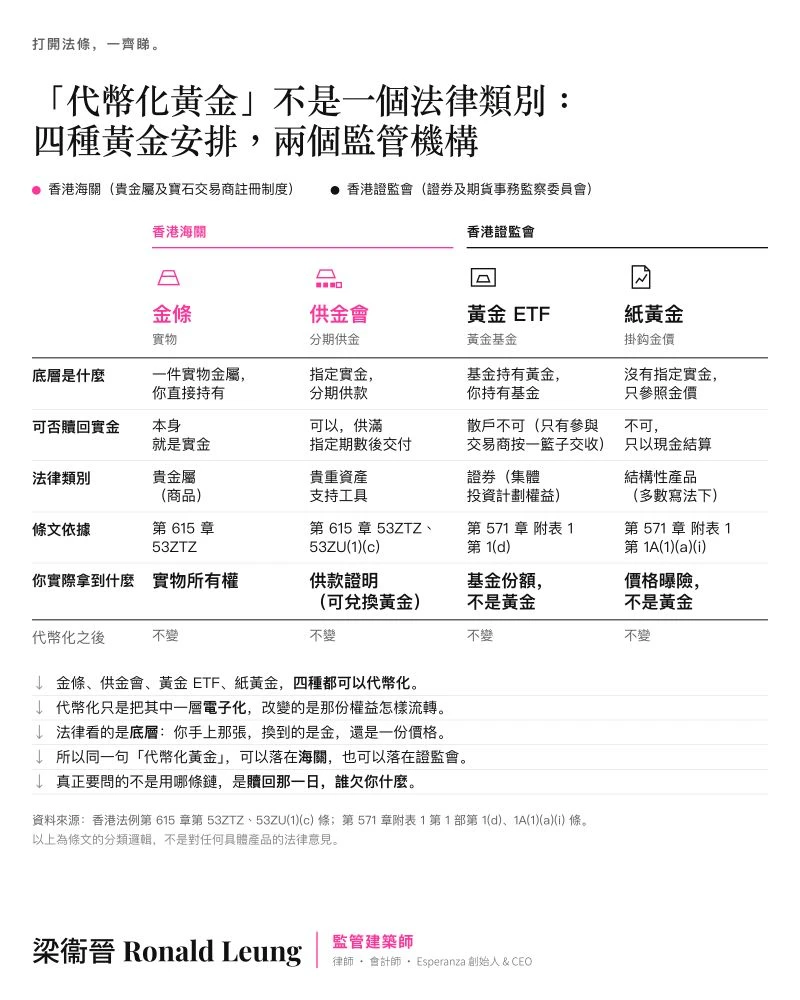
Different structures sit with different regulators. Physical bars and gold instalment plans sit with Hong Kong Customs; gold ETFs and paper gold, being collective investment schemes and structured products, sit with the Hong Kong SFC. Tokenise any of them and the regulator follows the structure.
All four can be tokenised. Tokenising digitises one layer. It changes how the right moves; the right itself is unchanged.
Most people assume every tokenised product is the SFC's responsibility. That is unfair to the SFC — where a complaint concerns a product that is neither a security nor a virtual asset, it has no statutory power to assist or to enforce.
So the question is not which chain. It is how the legal rights and the risks change across the life cycle of a tokenised product.
The statutory basis for every column is on the chart — Cap. 615 and Cap. 571.
A journalist asked me this week whether tokenised gold is regulated by Hong Kong’s Securities and Futures Commission.
I could not answer without knowing whether it was a tokenised investment product. It depends on the legal structure in which the gold is presented.
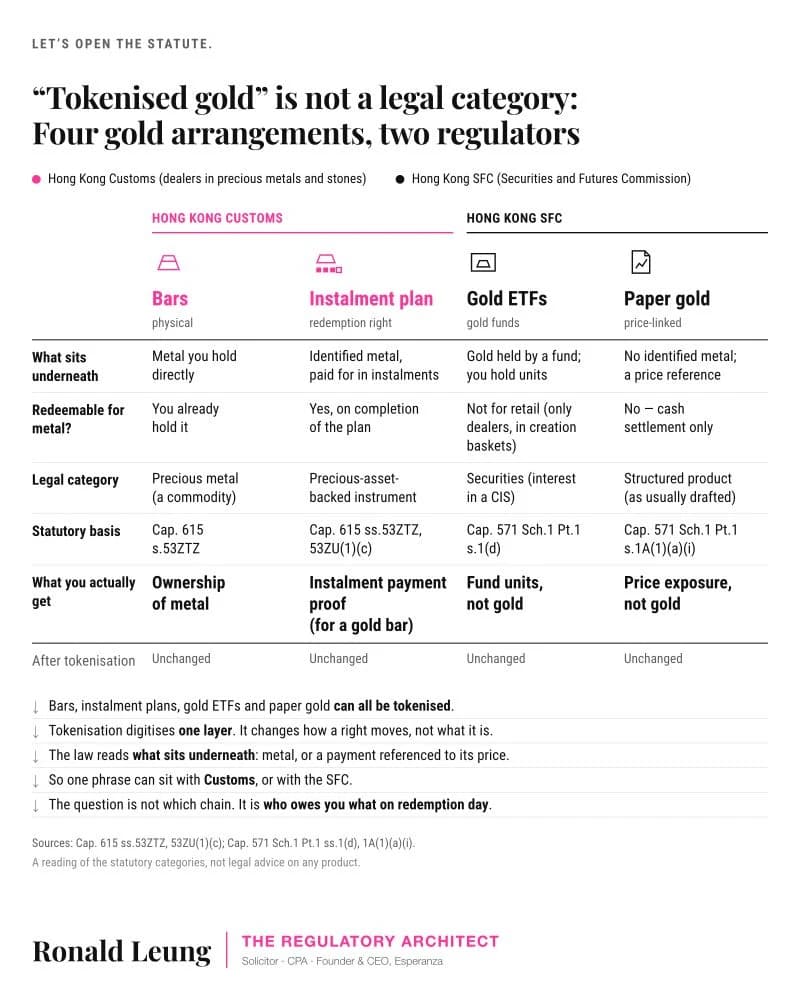
Different structures have different regulators: physical gold bars and gold-purchase schemes fall under Hong Kong Customs, while collective investment schemes and structured products such as gold ETFs and paper gold fall under the SFC. After tokenisation, the regulator follows the structure.
All four can be tokenised. Tokenisation simply digitises one layer. It changes how the interest circulates, not the interest itself.
Many people currently assume that all tokenised products are the SFC’s responsibility. That is not fair to the SFC either: in many complaints about products that are neither securities nor virtual assets, it has no statutory power to assist or enforce.
So the question is not which blockchain is used. It is how the nature of the legal rights and risks changes throughout the tokenised product’s lifecycle.
The statutory basis for each column is shown in the diagram: Cap. 615 and Cap. 571.