

Ronald Leung’s original, dated commentary is reproduced below. Views, invitations and product references reflect the time of publication; they are not investment advice, an offer, a guarantee of return or confirmation of current availability.
The UK is developing a framework for tokenised gold. Its stated reason deserves a second reading: to preserve London’s position.
The Financial Times report on 10 August put it as “to protect the dominance of London in global bullion trading”. London accounts for around 70% of global gold trading and has one of the world’s largest vault networks. If a city with the world’s largest gold vaults needs new rules to defend its position, what it is defending is not the vaults.
In SCMP’s five-year-plan series on 13 August, the chairman of the Hong Kong Securities and Futures Professionals Association proposed a goal: make Hong Kong the gold-pricing centre for the Asian time zone. That is the right direction.
But much of the discussion among industry and policymakers is about filling vault capacity. Vaults are necessary: without gold on hand, there can be no physical settlement.
The real question comes next. When the vaults are full, what does Hong Kong intend to do with the gold?
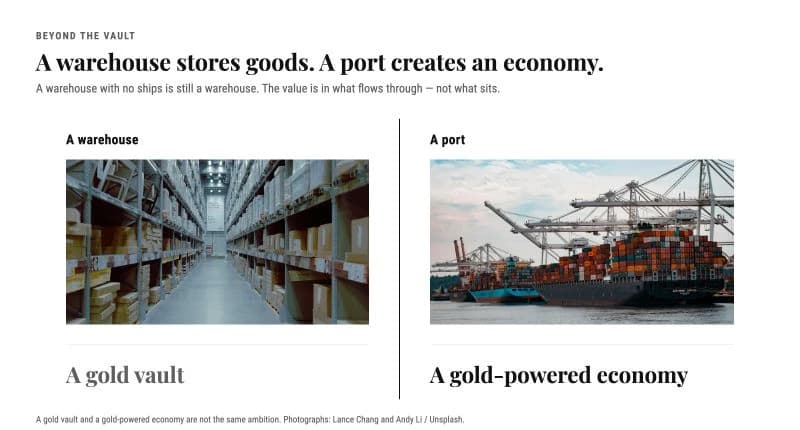
Does Hong Kong want to be a warehouse, or a “port”?
A warehouse earns rent: gold arrives, lies there, and is charged by storage space.
A “port” serves a regional economy.
Hong Kong became a port through the bill of lading: a piece of paper could transfer ownership several times while the goods remained in storage.
Gold follows the same principle. What matters in a hub is how quickly ownership can change, while the gold in the vault need not move at all.
Tokenised gold is a key tool for turning physical gold in a vault into a transferable instrument that can settle economic activity.
The good news is that Hong Kong already has the conditions for a workable tokenised-gold ecosystem. The provisions were written years ago. Section 53ZTZ of the Anti-Money Laundering and Counter-Terrorist Financing Ordinance (Cap. 615) defines “precious-asset-backed instruments” and distinguishes them, point by point, from securities.
Full article (English): https://lnkd.in/gwbU_rAR
#RegulatoryArchitect #UnderstandingWhatRegulationActuallySays #TokenisedGold